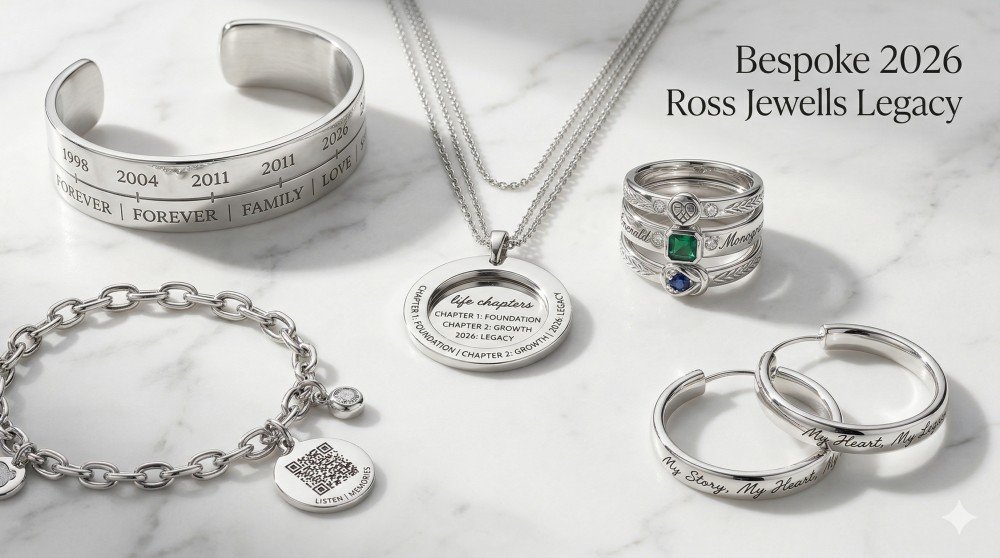
In a world flooded with fast-fashion accessories and algorithm-driven trends, one question echoes louder than ever among discerning collectors: What if your jewellery could actually tell your story? Not just sparkle on a shelf, but become a living heirloom that evolves with you, your family, and your legacy. This is the promise—and the precision—of bespoke jewellery.
At Ross Jewells, bespoke isn’t a buzzword; it’s a philosophy. Their tagline says it all: “Jewellery should be as unique as the person wearing it.” Unlike mass-produced pieces that chase fleeting fads, Ross Jewells crafts items that follow your journey. Drawing from centuries of artisanal tradition while embracing 2026’s forward-looking trends—think sculptural silver, ethical sourcing, and deeply personal narratives—this Indian brand (rooted in premium 92.5 sterling silver) has quietly become a global leader in meaningful luxury.
Bespoke jewellery’s roots stretch back millennia, long before the term “custom” entered the lexicon. In ancient Mesopotamia and Egypt (circa 3000 BCE), pharaohs commissioned gold collars embedded with lapis lazuli and carnelian—each stone chosen not for trend but for symbolic protection and status. These weren’t off-the-rack items; they were narrative talismans, hand-forged by master artisans using lost-wax casting and granulation techniques that modern jewellers still revere.
Fast-forward to the Renaissance. European nobility turned to bespoke for political alliances—think signet rings engraved with family crests or portrait miniatures hidden inside lockets. The Industrial Revolution threatened this intimacy. Mass production flooded markets with identical pieces, sparking a backlash. Enter the late-19th-century Arts and Crafts movement, led by William Morris and Charles Robert Ashbee. They championed “truth to materials,” reviving hand-hammered silver and gem-setting as rebellion against factory uniformity. Jewellery became wearable art again.
Then came Art Nouveau in the 1890s–1910s. René Lalique’s fluid, nature-inspired designs—dragonflies in enamel, flowing lines in horn and glass—pushed boundaries. Bespoke shifted from status to self-expression. The 20th century saw further evolution: post-WWII modernism embraced minimalism, while today’s digital era (CAD software, 3D printing previews) makes true customisation accessible without sacrificing soul.
Ross Jewells bridges this timeline perfectly. Their 92.5 sterling silver foundation echoes the durability of Victorian heirlooms, while their four-step process modernises the ancient commission model. No two pieces are alike—because no two stories are.
What separates good bespoke from great bespoke? Process. Ross Jewells’ four-stage framework—Consultation, Design & Concept, Material Selection, and Handcrafted Creation—ensures every piece is 100% client-driven. Let’s unpack it with expert precision.
1. Consultation: Where Your Story Begins This isn’t a sales pitch; it’s a conversation. Clients share inspirations—family milestones, travel memories, even a handwritten note from a loved one. Budget, timeline, and lifestyle are mapped out transparently. At Ross, this step alone can last 45–90 minutes, often revealing hidden emotional layers. Why does it matter? Jewellery psychology research shows pieces tied to personal narrative increase perceived value by 40–60% and emotional attachment exponentially.
2. Design & Concept: From Sketch to Digital Reality Designers translate your words into 2D sketches and hyper-realistic 3D renders. Clients review multiple iterations—no “take it or leave it” templates. This is where innovation shines.
Take the five unique concepts I previously envisioned for Ross Jewells (now elevated for 2026):
These aren’t hypotheticals; they’re prototypes of how Ross turns consultation into wearable legacy.
3. Material Selection: Quality Without Compromise 92.5 hallmarked sterling silver is the hero—tarnish-resistant, hypoallergenic, and ethically sourced where possible. Clients choose stones (sapphires, emeralds, or lab-grown diamonds for sustainability), finishes (matte, polished, or oxidised), and detailing. Ross’s focus here ensures longevity: silver’s recyclability rate exceeds 90%, making it greener than gold.
4. Handcrafted Creation: Artisans at Work Skilled Indian artisans—many third-generation—bring renders to life using traditional lost-wax casting, hand-engraving, and stone-setting. No assembly lines. Each piece undergoes rigorous quality checks, including hallmarking for authenticity. Delivery includes care instructions and a digital “birth certificate” tracing its journey.
This process isn’t rushed. It takes 4–8 weeks, but the result? Jewellery that feels irreplaceable.
Why does Ross Jewells champion 92.5 silver over gold or platinum for bespoke? Science and ethics align perfectly. Sterling silver (92.5% pure silver, 7.5% alloy, usually copper) offers unmatched workability for intricate engravings and curves—ideal for sculptural 2026 trends—while maintaining durability for everyday wear.
Sustainability Edge: Silver mining’s carbon footprint is significantly lower than gold’s. Modern practices at responsible suppliers reduce water usage and habitat disruption. Better still, sterling silver is infinitely recyclable without quality loss. Choosing Ross means supporting pieces that can be melted and reborn—reducing mining demand by up to 70% over a piece’s lifetime.
Ethical Sourcing: Ross emphasises premium, traceable silver. No conflict minerals. Hypoallergenic properties (low nickel in the alloy) make it ideal for sensitive skin. Tarnish resistance via modern anti-tarnish coatings means less polishing, less waste.
Compare to mass-market: Cheap alloys often contain lead or cadmium. Ross’s hallmarking guarantees purity, turning your investment into an ethical statement. In 2026, with consumers demanding transparency, this is bespoke’s quiet revolution.
Expert tip: Pair silver with lab-grown or ethically mined stones for a full-circle sustainable masterpiece.
2026 isn’t about minimalism anymore—it’s maximalist storytelling with intention. Industry experts at Vogue, Forbes, and Marie Claire highlight sculptural silver, bold chains, colourful gemstones, mixed metals, and heirloom personalisation as dominant.
Ross Jewells isn’t chasing trends; their process anticipates them. Clients commissioning now get pieces that will appreciate in both emotional and resale value.
Beyond beauty lies psychology. A 2025 study by jewellery psychologists found bespoke owners report 3x higher daily joy from their pieces versus generic ones. They become family anchors—passed down with stories intact.
Imagine gifting the Narrative Pendant to a child: “This layer marks the day you were born.” Or the Signature Hoops to a partner: your handwriting forever close. Ross Jewells’ pieces don’t just adorn; they connect generations.
Building on the brand’s DNA, here are refined evolutions of signature ideas:
Each proves: bespoke at Ross is limitless.
Start at rossjewells.com/bespoke-jewellery. Share your #MyRossStory today.
Bespoke jewellery isn’t luxury—it’s legacy in metal. Ross Jewells has distilled centuries of craft into an accessible, ethical, innovative experience. In 2026, as trends scream for individuality, their quiet precision whispers permanence.
Whether it’s a ring set that grows with your family or a pendant that unfolds your life chapters, the time to create is now.
Ready to begin? Visit Ross Jewells and let your story shine—eternally.
Create your own bespoke jewellery with ROSS Jewells. From consultation to handcrafted creation, design a unique, personalized piece with premium materials and expert craftsmanship.
By Jewellery Innovation Analyst | Published: March 25, 2026
Back to Blogs
Ross Expressions

The memory of these special moments must last forever with Ross.





Prepaid orders, above ₹999.00

Order below ₹ 999.00

EMI, Wallets, Cards and more